Glossary
The metal industry uses a wide range of technical terms, coatings, finishes, and manufacturing processes. Our glossary defines the terminology commonly used throughout the industry and across Steelscape products to help you better understand specifications, technical documents, and product information.
ASTM Standards
The American Society for Testing and Materials is an independent standards organization that regularly publishes testing and performance specifications for a wide variety of industrial products.
Backers
The underside of painted metal used in metal roofs and walls with base color, some protection, and a substrate (basis) for adhesives. A backer is typically white or neutral color.
Bonderized
The thin layer of Zinc Phosphate on the surface of the sheet that is a weldable product and provides a surface to which paint will readily adhere. This is typically used in rainwater goods such as gutters and flashings for metal roofs.
Camber
The curving or deviation of sheet metal from a straight, vertical plane. Also related to sweep, the curving or deviation of sheet metal from a straight, horizontal plane.
Capillary Action
The movement of water through microscopic pores or channels within metal. As water molecules are ‘sticky’ they can flow through narrow spaces often against external forces such as gravity. Usually occurs when an exposed end of bundled painted steel is in proximity to water due to improper storage, allowing water to travel through the metal and cause wet stack corrosion.
Chalking
Chalking is the degradation of the resin system at the surface of the finish on a metal roof or wall, due predominantly to prolonged UV ray exposure. As the resin breaks down, resin particles along with embedded pigment particles lose adhesion and take on a white appearance.
Clear Coat
A clear coat is an optional layer applied over the paint topcoat, designed to add perceived depth to the surface, enhance gloss, or provide additional protection in extreme environments such as coastal or industrial settings.
Cool Colors
Cool colors refer to a coating for metal roofs that uses chemically and physically altered infrared (IR) reflective pigments to reflect IR wavelengths while still absorbing the same visible light. Reflecting infrared light reduces the heat buildup in structures, thus reducing building cooling costs.
Cut-To-Length
Cut-to-length is a manufacturing process in which metal products, typically metal coil, are cut to the exact specifications of an end-user or manufacturer for use in metal roof and wall products.
Delamination
Delamination is the loss of paint film adhesion to the substrate or between the primer and the topcoat. It can be visually apparent in several forms including bubbling, peeling, checking, chipping, cracking, or complete loss of the topcoat on a metal roof.
Directional Paint System
Due to the unique shape of the pigments in metallic paints, a directional paint system catches light in a specific way that can vary between batches and orientations. This guidance is given for certain colors to avoid mixing orientation or batches to provide a clean, uniform look once installed on a metal roof or wall.
Dissimilar Metals
Refers to metals that are in different positions on the galvanic scale relative to one another. Two dissimilar metals in close proximity in a conducive environment can lead to galvanic corrosion, in which one metal corrodes preferentially (and sometimes rapidly) compared to the other. This is due to the ‘flow’ of current from one metal to another.
Edge Corrosion (field cutting induced)
Corrosion at the exposed, thin, unpainted end of a metal panel. Often created due to field cutting of panels by a heat-generating device such as a grinding disk or Sawzall (compared to a manufacturer’s shear or shearing action used on a jobsite to cut material), which leads to an inconsistent, exposed edge which can trap water and spread corrosion more rapidly.
Edge Wave (slitter- or roll-former-induced)
The visible, unintentional waviness or buckling at the edge of a metal strip due to forces imparted on the strip during the production or forming process. Often due to improper production or quality control processes.
Electrolysis
Electrolytic Corrosion created by two or more dissimilar metals in contact with each other and an electrolyte containing small amounts of acid. A common example is moisture in a coastal environment. This leads to galvanic corrosion, in which one metal corrodes preferentially over the other.
Embossing
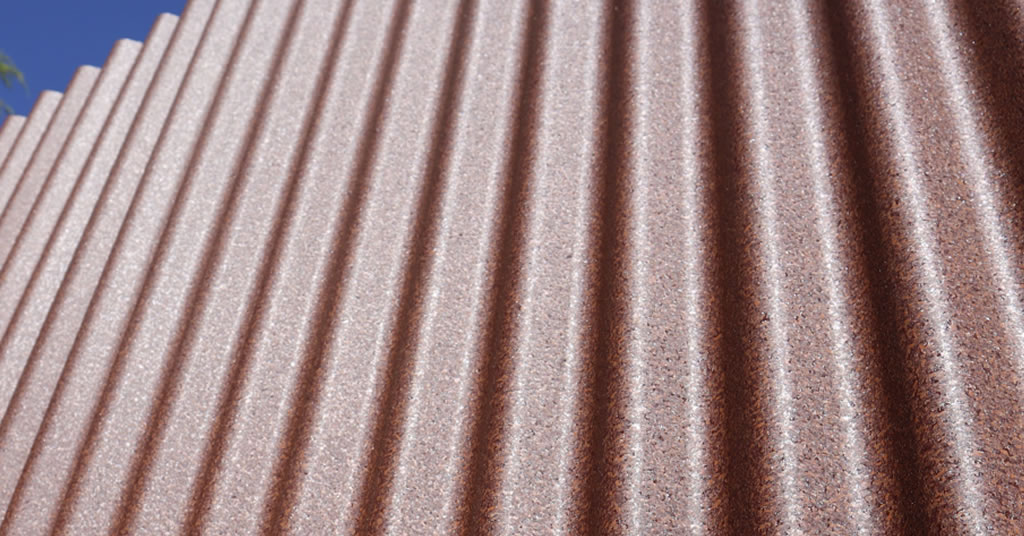
Embossing is the process of creating a raised texture to the surface of the metal. Undertaken as part of a continuous process for metal applications, such as metal walls.
Emissivity
Emissivity is the amount of heat a surface can dissipate away from itself. This is expressed as a percentage between 0-100%. Used in calculating the Solar Reflectance Index for metal roofs.
Fading
Fading occurs when UV rays and environmental substances attack the paint’s pigments, causing their color to change. Color change is typically assessed by its deviation from the base state when new, expressed as Delta E (dE or ΔE).
Film Thickness
Film thickness, or dry film thickness (DFT), refers to the thickness of the paint film on the strip surface after the paint has cured. Typical dry film thicknesses for painted steel for metal roof and metal products range from 0.0005″ (0.5 mil) to 0.0015″ (1.5 mil).
Flexographic Roll Printing
Flexographic roll printing is the process Steelscape employs to impart its distinctive colors and designs, such as rustic and aged metallics, onto metal for metal roof and wall products.
Galvalume®
See ZINCALUME®
Galvanic (bimetallic) Corrosion
The preferential corrosion of one metal over another, occurring when two dissimilar metals are in contact in a conducive environment (e.g., moisture and acid). Heightened by how dissimilar the metals are on the galvanic scale and how conducive the environment is (e.g. more prominent on the coast than in the desert).
Galvanizing
Galvanizing is the process of coating steel with a thin layer of zinc to improve corrosion resistance. Referred to by Steelscape as TruZinc.
Gauge
Gauge refers to the thickness of metal. A smaller gauge correlates with a thicker metal. For example, 22ga is thicker metal than 29ga. 22ga-29ga are also the most common gauges for metal roof and metal wall building applications. Sometimes spelled as gage.
Gloss and Sheen
Gloss and sheen are two terms used to describe how well a surface reflects visible light. Gloss is measured at a 60° angle from the surface, while sheen is measured at 85°.
Graffiti Resistance
For Steelscape applications, graffiti resistance refers to a painted metal wall surface from which aerosol or marker-based graffiti can be removed.
Inert Catchment
When acidic rainwater, formed under certain environmental conditions, causes corrosion in areas downstream of the catchment surface, such as gutters and downpipes. Avoided by ensuring the correct material is selected relative to its environment.
LEED
Leadership in Energy and Environmental Design (LEED) is a green building rating system developed based on a pre-developed framework for healthy, efficient, and environmentally sustainable structures.
Light Reflectance Value (LRV)
LRV measures the amount of visible or usable light reflected from a surface. LRV is expressed as a percentage from 0 to 100; the higher the number, the more visible light that is reflected. Used for both metal roofs and metal walls.
Metallic Coating
Metallic coating refers to the process of applying additional metal elements, typically Zinc (galvanizing) or Aluminum and Zinc (ZINCALUME® or Galvalume®) to steel to improve the corrosion performance of metal roofs and walls.
Mica
A specially formulated pigment added to paint for metal roofs and walls to create a sparkling or light-catching effect. This creates the effect of metal flakes in paint but with higher durability.
Oil Canning
Oil canning is a visual phenomenon characterized by waviness or distortion in the flat surfaces of metal roofing and siding products. This effect is caused by a range of factors, including stresses in the base material, improper fastener pressure, misaligned panels, and thermal expansion.
Paint
Paint is the film applied to a surface to achieve a desired aesthetic and protect the underlying material. This typically consists of resins, solvents, and pigments. Pigments add color; resins are the binder and provide physical and chemical properties; and solvents dissolve this combination into a liquid.
Paint System
The paint system consists of a combination of the different painted layers, namely the pretreatment, primer, and topcoat, to create a total finish solution. Paint systems can be modified to achieve different aesthetic or performance characteristics.
Polyester Paint
Polyester Paint is the most economical metal roof paint system and offers the lowest level of UV resistance when compared to SMP (Silicone-Modified Polyester) and PVDF (Polyvinylidene fluoride) systems. Versatile and easy to form, their paint structure can be modified to suit a wide range of performance qualities, and their flexibility allows them to be offered in a variety of color and gloss options.
Pre-painted Metal
Pre-painted metal is the continuous process of coating steel rolls, called coils, with paint (also called coil coating). This type of metal is used in metal roofs and walls. The paint applied to metal before it is formed into a finished product by a manufacturer is called pre-painted metal.
Pressure Mottling
Uneven or irregular gloss visible on painted steel (often in a splotchy or speckled pattern) due to variations in the pressure applied to the metal’s painted surface during storage in coil form. Typically, a temporary condition that will dissipate with time.
Pre-treatment
Pre-treatment is a coating process applied before painting, in which the metal surface is cleaned to improve paint adhesion and the longevity of painted metal roof and wall products.
Primers
Primers are coatings that prepare the substrate for painting by providing ‘bite’ for adhesion and directly support topcoat color and flexibility. Primers also provide corrosion resistance for metal roof and wall products.
PVDF
(Polyvinylidene fluoride, also known as Fluorocarbon or Kynar 500® and Hylar 5000®)
Polyvinylidene fluoride (PVDF) is the highest performing of the three common paint systems. It offers exceptional resistance to chemicals, chalk, and fading. It can resist degradation when exposed to aggressive weather elements such as urban grime, air pollutants, salt, high temperatures, and humidity. PVDF is most often used for high-end architectural and high-profile commercial metal roof and wall projects.
Reverse Impact Test
A reverse impact test is a stress test performed to determine whether any paint adhesion is lost due to direct impact from the underside of the material. Like the T-bend test, this simulates the final forming into the finished metal roof and wall product.
Roll Forming
Roll forming is the process used to manufacture most metal roof and wall products. A continuous production process where material is fed through a series of progressive rollers to form it into a finished state. Enables the end panels to be manufactured to the desired length for the end-user.
Self-Healing Properties
In metallic coatings such as ZINCALUME® or Galvalume®, the galvanic action causes the zinc compounds to automatically build up at cut edges and scratches by an electrolytic reaction when water or moisture is present, slowing the rate of corrosion. This effect is sometimes referred to as “self-healing”. These properties are more pronounced on a factory-cut edge with a shear, where it is smooth and consistent, as it essentially folds the Zincalume coating over the exposed raw edge of the base steel. Field cutting (provided it’s done with a shearing action) can yield the same results as a factory-cut edge.
Silicone-Modified Polyester (SMP)
A paint system with a different resin structure that improves UV resistance compared to traditional polyester systems. SMPs offer greater resistance to chalking and fading than traditional polyester systems and are commonly used in residential metal roof applications.
Slitting
Slitting is a manufacturing process in which the width of a metal coil is trimmed to a desired size, or in which one metal coil is slit to form multiple narrower coils for use in metal roof and wall products.
Solar Reflectance (SR)
The amount of solar radiation reflected off a metal roof or wall surface. This is expressed as a percentage between 0 and 100%.
Solar Reflectance Index (SRI)
The most common index used to measure the reflectivity effectiveness of a color for a metal roof or wall. The consolidated value is calculated from solar reflectance and emissivity, with factors such as airflow considered. The higher the value, the greater the reflectance. This is expressed as a range, with a standard black surface having an initial SRI of 0 and a standard white surface having an initial SRI of 100.
Spangle
Spangle is a term to describe the distinctive finished pattern appearance of unpainted ZINCALUME® or TruZinc® steel.
Swarf
Swarf refers to the small metallic filings created when metal roofing or siding products are pierced or cut with friction saws, abrasive discs, or drills. If these tiny particles are left on a metal surface, they can corrode and cause rust stains.
T-Bend Test
The T-Bend Test simulates forming of metal into products and assesses the flexibility of painted metal. During this test, a bend is formed in the test sample and inspected for any cracking.
Tension Leveling
Tension leveling is an in-line process on both Steelscape metallic coating lines and the Kalama Pickle Line, which induces tension into the strip in excess of the yield strength. Tension leveling results in a flatter product with improved properties for subsequent product forming.
Toll Forming
Toll forming is the process of coating or painting metal in which the base metal is provided or owned by the end-user.
Topcoat
The top painted layer of metal that provides color, offers protection from the elements, and enhances durability and weather resistance.
TruZinc®
A metallic-coating consisting of 100% zinc, offering corrosion resistance. Applied using Steelscape’s advanced production processes. TruZinc Steel is an exceptionally versatile product, ideal for a range of applications, including metal roof and wall products, HVAC ducting, lightweight framing and decking, and other building accessories.
Wet Stack Corrosion
The creation of corrosion or blistering to the surface of metal when stored in stacks and bundles. Due to trapped water between metal sheets, capillary action of water through the metal ends, or other moisture exposure from improper storage of the metal.
White Rust
The presence of a white, chalky substance on the surface of bare galvanized products. Typically occurs when new galvanized products are exposed to moisture or condensation before the zinc coating has stabilized.
Yield Strength
Yield strength represents the stress at which materials transition from elastic to plastic deformation. Once a material has been loaded past its yield point, it is permanently deformed, making it unsuitable for use in metal roof and wall products.
ZINCALUME® (Galvalume®)
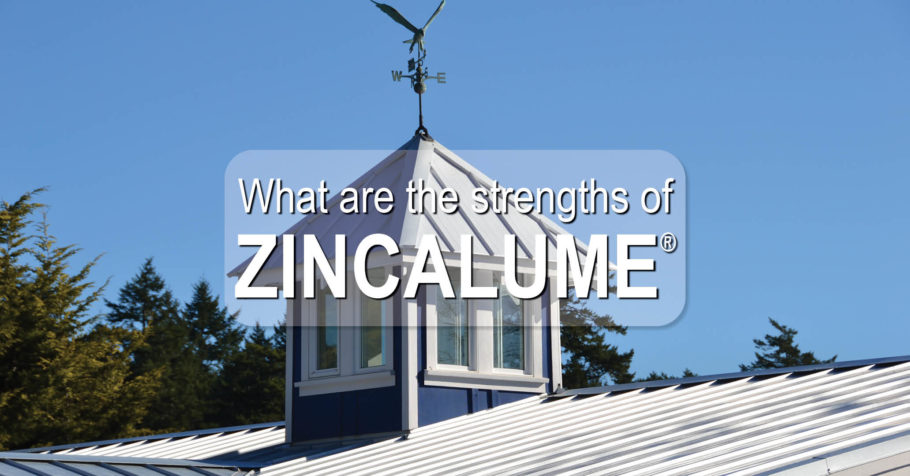
A metallic coating consisting of 55% Aluminum and 44% Zinc, offering superior corrosion resistance. Coatings using the aluminum-zinc alloy offer several advantages over zinc alone. Aluminum is inert and provides a protective rather than sacrificial barrier compared to zinc. This combination is the common industry standard used for metal roof and wall products.